What happens when a room of artists and technologists sit on the floor and design human wireframes and interfaces?
The room before anything started
Get there early. That’s always the instruction I give myself before a workshop.
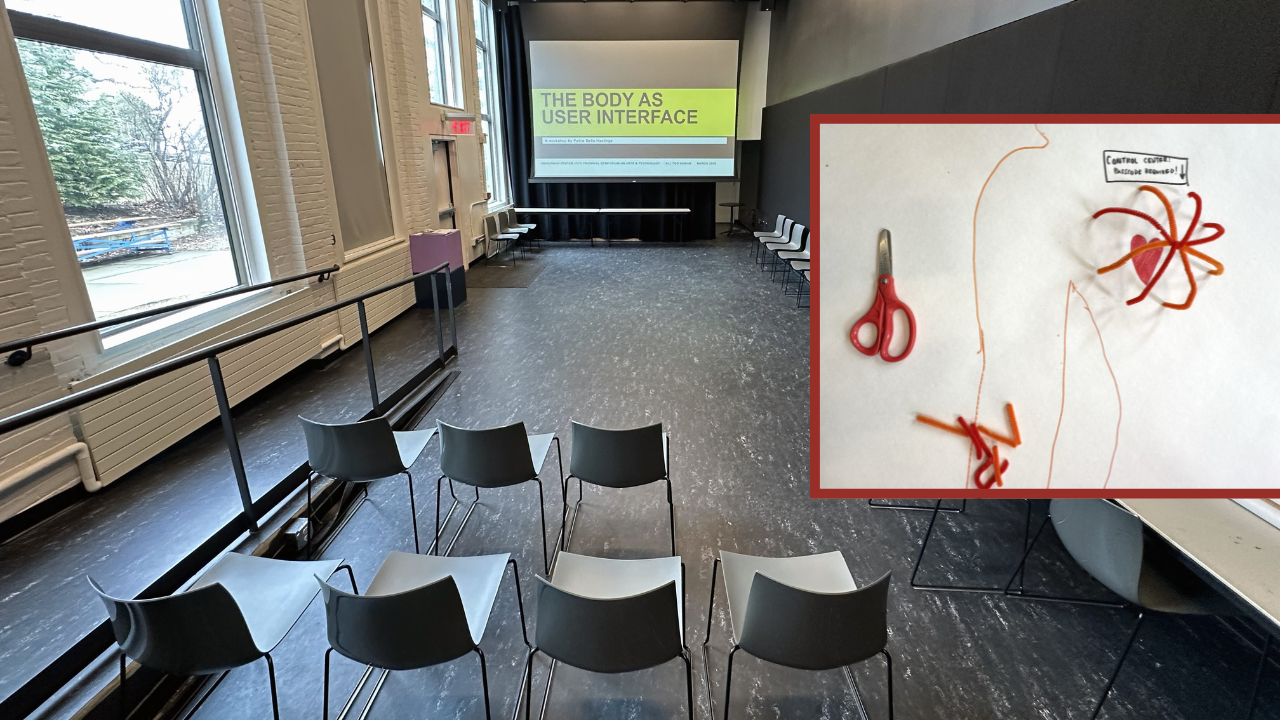
I arrived at the studio theater at Connecticut College with time to spare. It was exactly the right kind of room: black walls, theatrical lighting rigs overhead, a large projection screen at the front, a dark hardwood floor that would soon be covered in paper. I had rolled white paper on the side tables, markers, and collage materials in bins, and zines stacked at the entrance. I pulled up the first slide, sat in meditation, and waited.
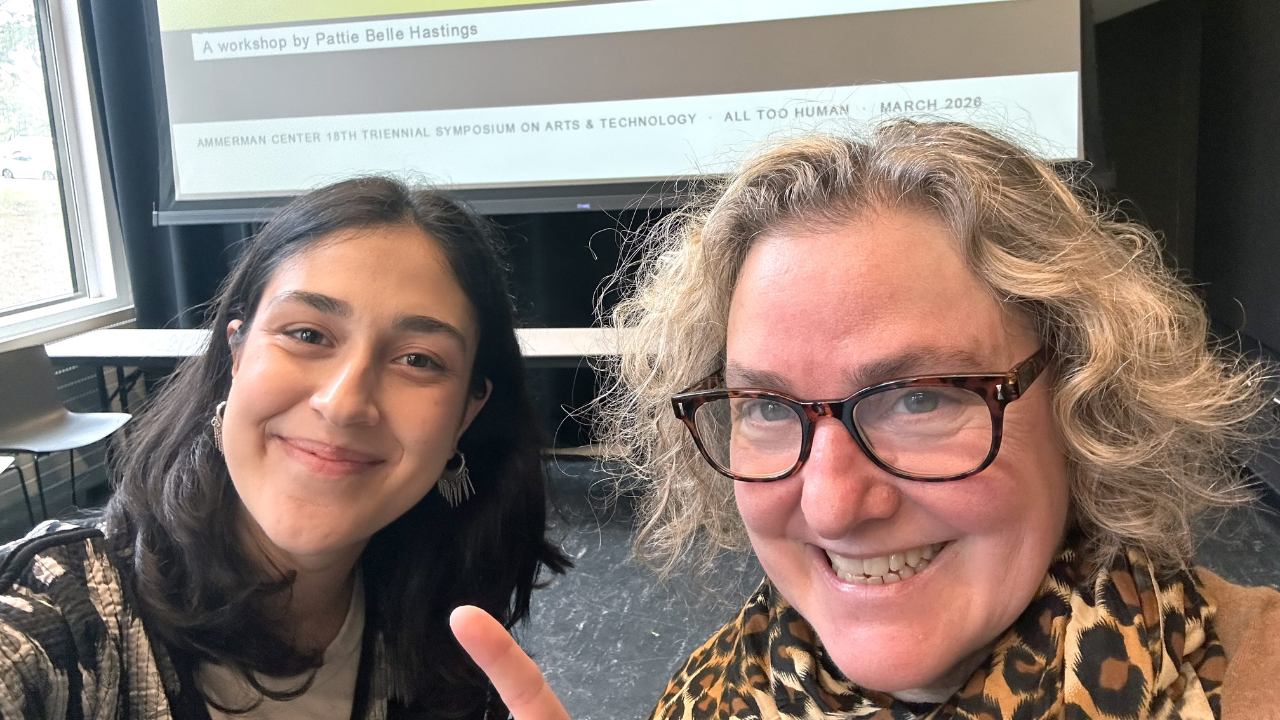
The Ammerman Center for Arts & Technology had just opened its 18th Triennial Symposium, a gathering of artists, researchers, and technologists under the theme All Too Human. My workshop was the embodied answer to that question: what does it mean to be irreducibly, unmistakably, gloriously human in a world that keeps trying to turn us into data?
The short answer, which I have been working toward for more than thirty years: you are already an interface. You have always been one. And nobody can replicate it.
How it works: 30/70
I run my workshops on a ratio. Thirty percent is mine: the frame, the lineage, the prompts, the parameters. Seventy percent belongs entirely to the participants. This ratio is not modesty. It is a commitment to the 70% being the actual thing: the unexpected design choices, the collaborative negotiations, the moments of recognition that I could not have scripted.
The 30% opened with movement. Before any theory, before any slides: we moved. Simple exercises to ground people in their actual physical bodies, shake off the morning’s accumulated sitting and listening, and begin building the kind of embodied trust that collaborative body-work requires. You cannot trace another person’s outline without paying them specific, careful attention. It helps to have already moved together.
Before returning to our embodied presence, I ran through the inspirations quickly but not superficially, just enough for each figure to land:
Hugo Ball, Cabaret Voltaire, Zürich, 1916
Ball performed in a costume of cardboard tubes that encased his body, immobilized his arms, and made him geometric and abstract. He produced sound poems (gadji beri bimba, glandridi lauli lonni cadori) that dissolved language into pure physical event. He refused to mean. He refused to serve. In 1916, with the most optimized killing machine in history running just across the border, the refusal of the rational body was the only sane response. The Dada body said: I will not be legible. I will not be useful. I am excessive, present, irreducible.
Ruth Zaporah’s Action Theater
Zaporah’s somatic improvisation practice begins not with a character or a script but with the body’s actual state: the weight of your hips, the pace of your breath, the quality of your attention right now. From this material, which is always available and always sufficient, a response arises spontaneously from encounter. The trained improvising body is not executing commands. It is in continuous conversation with its environment. It is, in the most literal sense, a responsive interface.
Brenda Laurel, Computers as Theatre (1991)
Laurel did something that should have changed everything: she picked up Aristotle and walked into the computer lab. Her insight, that interacting with a computer is fundamentally a dramatic experience, structured by agent, action, and scene, reframed HCI as a question of genuine agency. I take the reversal further: if the user is an agent in a drama, what if the body becomes the stage?
Drama therapy and family constellations
Moreno’s psychodrama and Hellinger’s constellation work rest on a shared premise: the body positioned in relational space generates knowledge that rational thought cannot access. The body knows, not metaphorically but materially ~ in its tissues and electrical signals. The felt sense that arrives before language.
This is the frame: the body as the oldest, most sophisticated interactive system we have. Inputs (touch, gaze, breath, proximity, temperature, heart rate). Outputs (expression, movement, color, rhythm, silence, presence). System states (loading, idle, overloaded, rebooting). An interface architecture more complex than anything currently shipping.
And yet we design interfaces that treat the body as if it is dumb: a pointing device, a surface to be touched. We ask it to simplify itself (thumb here, speak now) and we call this intuitive. It is not intuitive. It is a dramatic reduction.
The tracing
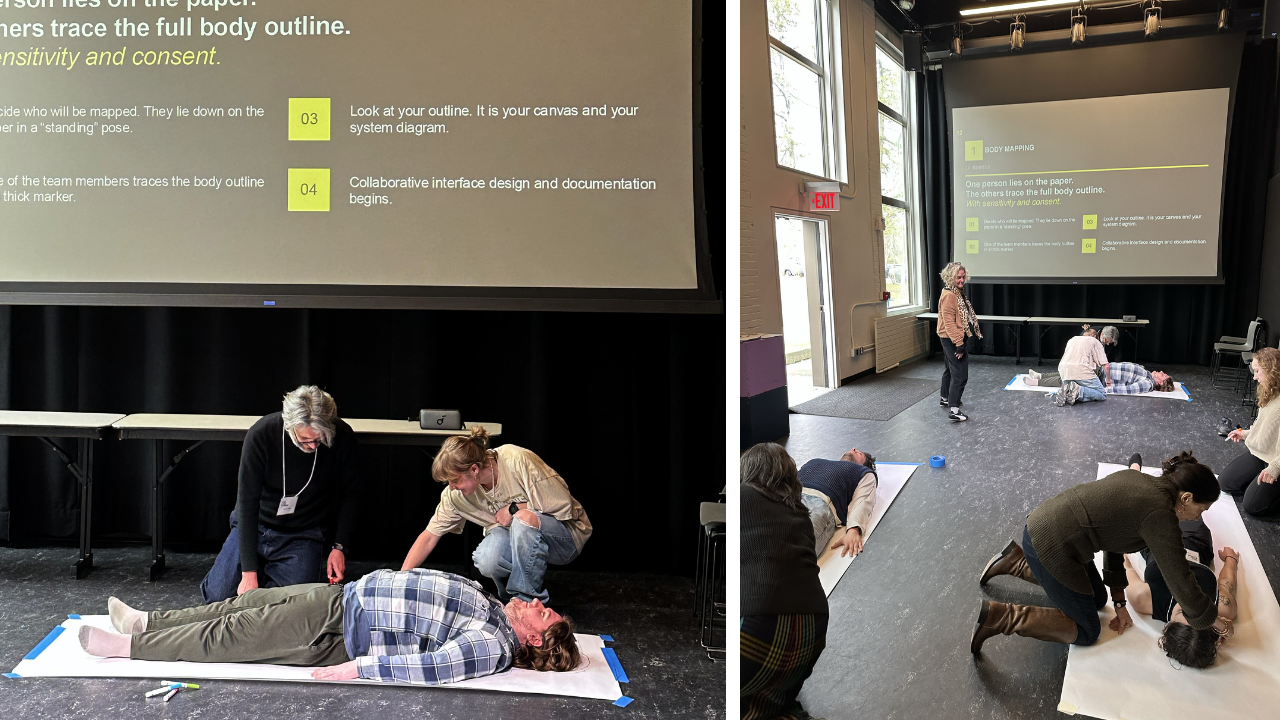
The slide changed: BODY MAPPING. One person lies on the paper. The others trace the full body outline. With sensitivity and consent.
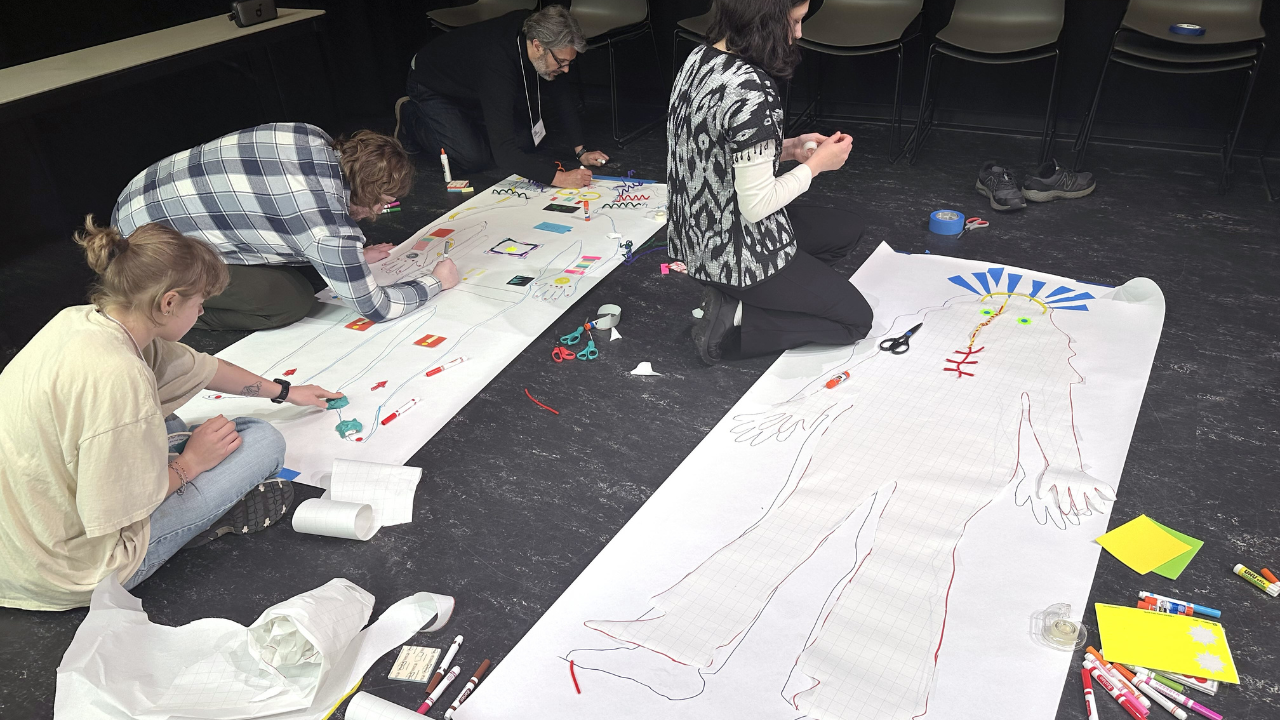
The paper went down on the black floor in four strips, each long enough for a full human body. A participant in each group lay down in what the slide called a “standing” pose: arms slightly away from the sides, legs slightly apart, the classic anatomical neutral. The others knelt around them with thick markers and began to trace.
There is something special that happens in this. The tracing requires care. You are following the edge of another person. You have to get close. You have to be deliberate. The body being traced has to trust that you’ll be accurate, that you’ll go where they actually are and not where you assume them to be. In ninety minutes of workshop time, this is an intensely relational act, and it changes the register of everything that follows.
Four outlines appeared on the floor: four silhouettes, each slightly different in proportion and pose, each waiting to become something. This is the outline of a wireframe for interaction.
The four bodies
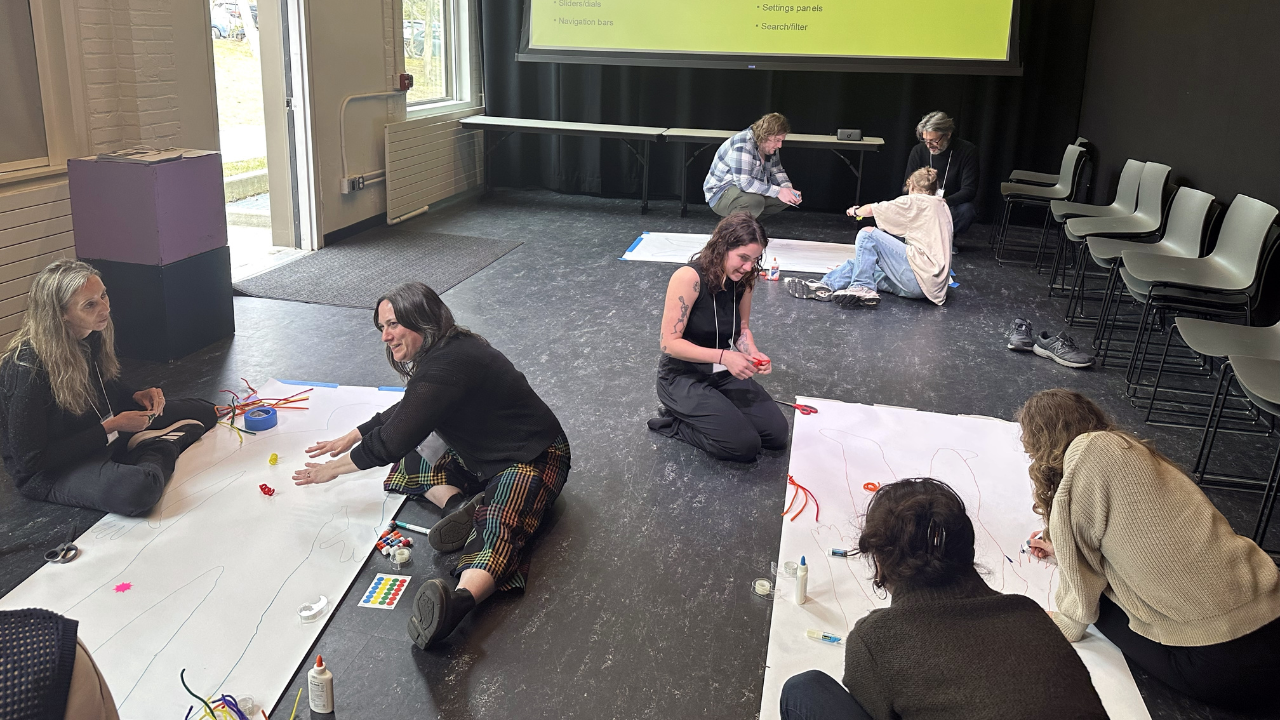
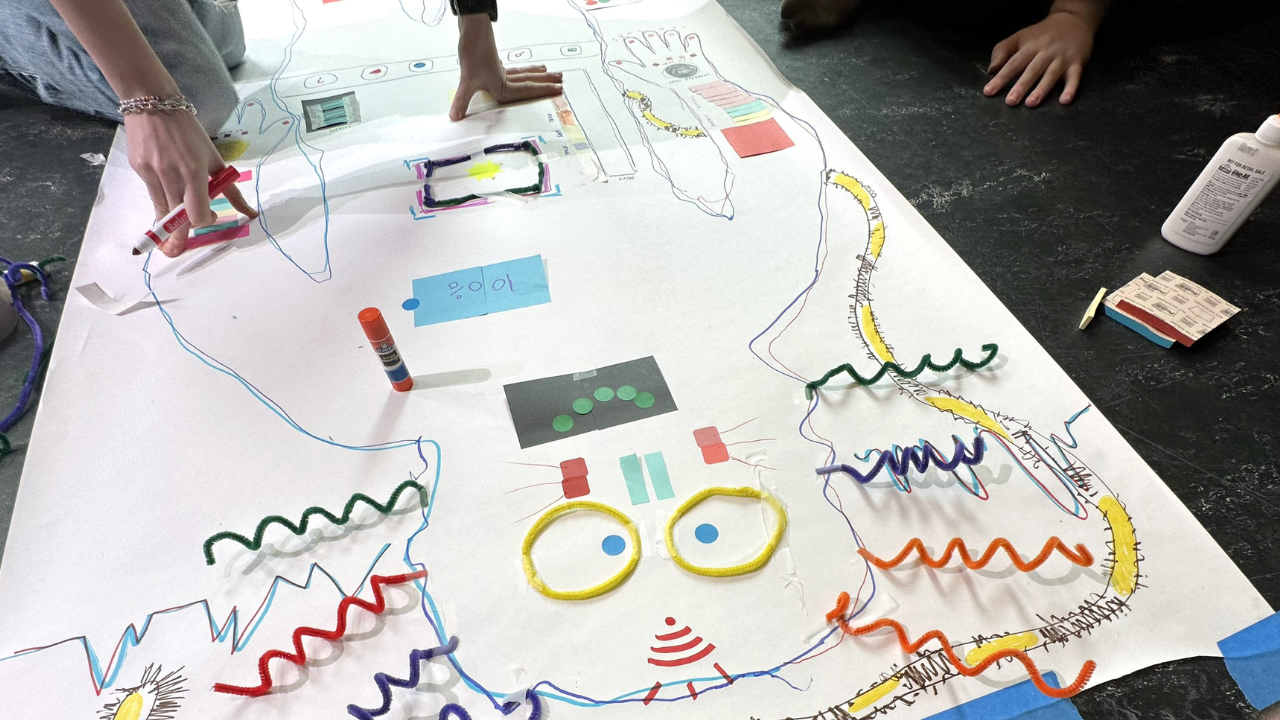
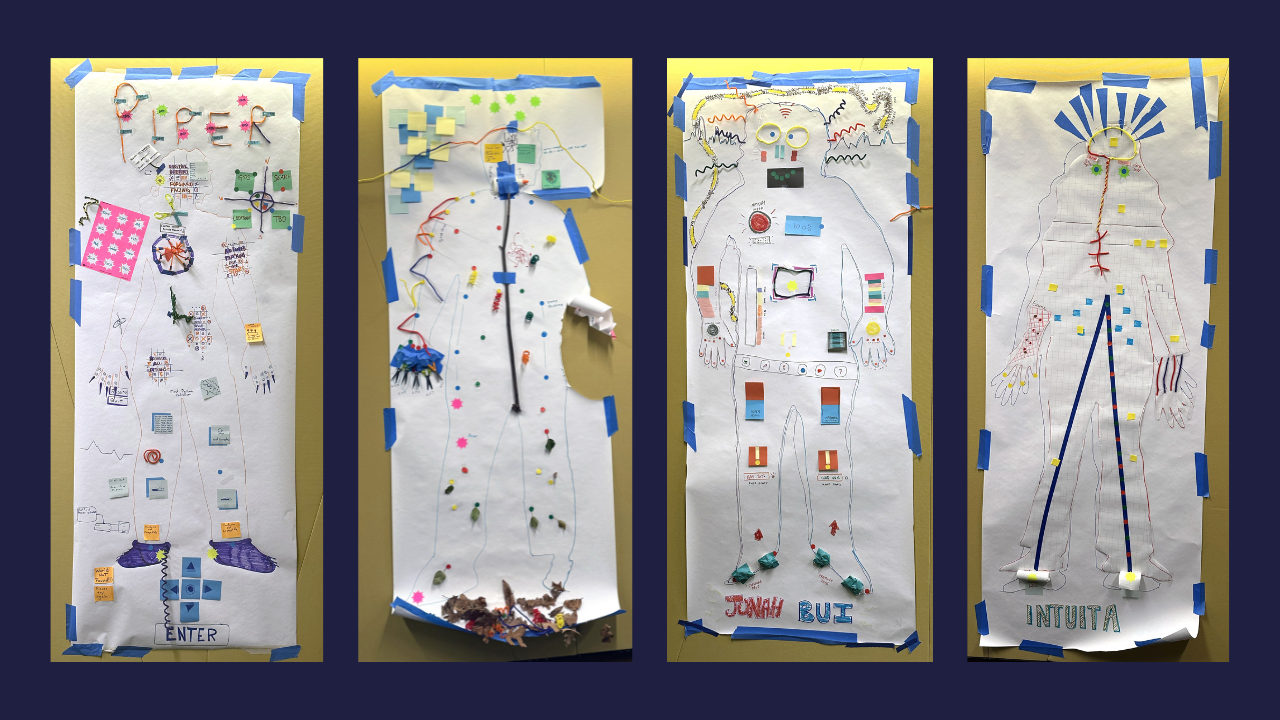
Then came the materials: markers of every color, post-its, tape (blue painter’s tape featured prominently as a structural element in at least two designs), yarn, wire, found objects, and collage materials. Each team had the same prompts and the same blank silhouette. What they made was completely their own.
INTUITA. The name is at the bottom in steady blue letters. This design was spare where others were dense, structural where others were decorative. Blue tape runs in a clean V from the hips down to both feet, like load-bearing cables or force lines ~ the body as architecture. A burst of radiating blue lines around the head, like a halo or an antenna array. Red thread stitched down the center of the torso in a careful, deliberate seam. Yellow dots are scattered as nodes, ports, or signal points. INTUITA trusted its own structure. It didn’t need to explain itself.
PIPER. The name in multicolored letters across the top; ENTER at the base. Purple boots at the feet, and at the center of those boots, a D-pad ~ a navigation control, the kind you’d find on a game controller. A clock or mandala at the center of the body, ringed with concentric marks and annotations. A pink polka-dot panel on the left chest. Notes throughout the design, including one that stopped me: do not press button without permission. PIPER had rules. PIPER had aesthetics. PIPER was a body that knew what it wanted and had opinions about consent.
JONAH BUI. The most wryly tech-literal of the four. Wi-Fi arcs on the head ~ because of course. A battery indicator on the chest. Colorful bars along the arms like an equalizer or signal-strength display showing emotional capacity in real time. A screen panel on the torso. Error-state messages are visible on the legs, and yellow warning markers. And at the feet: crumpled paper. A crashed state. Rendered in the most honest possible material: the detritus of a system that has been through too much.
UNTITLED. The fourth design took the opposite approach: maximal, organic, accumulative. Post-its clustered so densely around the head that they looked like a notification center that had never once been cleared. Colorful yarn and wire extended outward from the body in all directions ~ signals or connections that could not be contained within the silhouette. Materials at the feet included organic and found objects, the body grounding itself in something physical and specific. This interface was porous. It was accumulating. It was in continuous conversation with everything around it.
One team put the heart in a small cage. With a passcode required. The emotional core of the system: visible, protected, inaccessible without the right credentials.
That image, the caged heart, the passcode, is the one I keep coming back to. Because it is accurate. It is more accurate than any UX diagram I have ever seen. The heart is not simply an emotional input. It is a system with access controls. It has interface requirements. Not everyone gets in.
The gallery walk
When the design phase ended, we hung all four bodies on the walls. And we gazed.
A gallery walk in a workshop like this is not a critique. It is something quieter and more like recognition. You move through the work that the room has made together, and you see things you couldn’t see while you were making. You notice the choices, the shapes, the colors, the placements, the ideas, and the exploration.
What matters
I want to be precise about the stakes here, because this workshop is not nostalgia for the pre-digital or sentiment about analog practices. It is a response to a specific, contemporary condition.
The systems being built around human bodies are becoming very good at a particular bandwidth of human signal: the click, the gaze duration, the step count, the sleep score, and the purchase pattern. They are optimized for the legible body, or rather, the body performing for capture. As these systems improve, the pressure on bodies to perform legibility intensifies. The body that doesn’t simplify itself, that doesn’t produce clean data, that doesn’t comply. That body is NOT a problem to be solved.
Embodied practices (somatic training, improvisation, collaborative art-making) are, among other things, refusals of that legibility. They generate experience that cannot be fully captured, transmitted, or reproduced. INTUITA’s force-line architecture. PIPER’s rules about permission. JONAH BUI’s crumpled crash state. The heart in its cage with its passcode. None of those things will become training data. None of them will be optimized. They existed in that room, with those people, on that day, and they expressed something true that can only be pointed toward, never reproduced.
That is not a limitation. That is the whole point.
The materials are yours
Every resource from this workshop is freely available. Zine, agenda, essay, body diagram, slide deck. All of it. If you want to run it yourself, it’s there. If you want to adapt it, please do. If you want to trace bodies and design them in your own room, with your own people, around your own questions ~ GO.
→ All Workshop Materials — Google Drive
Pattie Belle Hastings
Artist, designer, facilitator. Fulbright Scholar (Oslo). Creator of Cyborg Mommy, Marsha McLuhan, and GenderMachine. Professor of Interactive Media + Design, Quinnipiac University. Her work is held at the National Museum of Women in the Arts, MoMA Library, Harvard, Yale, and Stanford.
The Body as User Interface was presented at the 18th Ammerman Center Triennial Symposium on Arts & Technology, Connecticut College, New London, CT, March 2026. Theme: All Too Human.

Hi there! I’m Pattie Belle Hastings.
But you can call me PB. I am a speaker, facilitator, designer, content creator, and professor. I facilitate teams and groups as well as design & lead workshops and courses on creative industry topics. I would love to design and facilitate your company’s creative breakthroughs.